Avi Alkalay Digital Awareness and Flying Spirit

Archive for tag “best:tech”

A Blogosfera 4 comments By AviPublished: Wed, 26 Dec 2007 11:47:14 -0200 Updated: Thu, 31 Jan 2008 18:56:42 -0200 Published: 26 Dec 2007 Updated: 31 Jan 2008 Published: 11:47 am Updated: 6:56 pm Categories: Community and SocietyEssaysWeb 2.0 Tags:

Um blog é um website qualquer cujo conteúdo é organizado como um diário (log, em inglês), ou seja, por datas e em ordem cronológica. O nome surgiu quando “web log” virou “weblog”, que em uma brincadeira se transformou em “we blog”, para enfim se popularizar em “blog”.

A cultura dos blogs tem um dicionário de jargões:

  • Post: um artigo ou publicação que pode conter texto, imagens, links, multimídia, etc. Um post tem um título, data e hora, é categorizado sob um ou mais assuntos como “vinhos”, “tecnologia”, “viagens”, “poesia”, etc., definidos pelo dono do blog. Usa geralmente linguagem mais direta e descontraída, e pode ser tão longo quanto um extenso artigo, ou conter somente poucas palavras. Um blog é uma seqüência de posts.
  • Comentário: visitantes do blog podem opinar sobre os posts, e esse é um lado muito importante da interatividade dos blogs.
  • Permalink: um link permanente, o endereço direto de um post específico.
  • Trackback e Pingback: um post que faz referência a outro post, até mesmo em outro blog.
  • Feed: há ferramentas que permitem ler vários blogs de forma centralizada, sem ter que visitá-los separadamente. O feed é uma versão mais pura do blog, contendo somente os últimos posts em formato XML (RSS ou ATOM), e serve para alimentar essas ferramentas. Podcasts nada mais são do que feeds contendo mídia, ao invés de só texto.

Blog é um nome mais atual para o que se costumava chamar de “home page”. A diferença é que antes da era dos blogs, uma pessoa que quisesse ter um website pessoal, tinha um enorme trabalho para publicar conteúdo de páginas, que geralmente eram estáticas, não interativas, e francamente, sem graça. Era um processo manual que exigia algum conhecimento técnico, e por isso eram geralmente os técnicos que publicavam conteúdo na web.

Com a padronização do conteúdo em ordem cronológica, em posts, surgiram uma série de ferramentas e serviços de blogging, sendo os mais conhecidos o WordPress, Blogger, LiveJournal e MovableType.

Eles facilitaram a publicação de textos, links, multimídia, de forma organizada e bonita, e a web ficou muito mais interessante. Se antigamente um escritor precisava ter influência com editoras para publicar trabalhos, hoje qualquer pessoa é um escritor em potencial. E, sim, os blogs revelaram inúmeros ótimos escritores — alguns viraram celebridades —, só porque agora eles tem acesso a uma plataforma de publicação independente e direta: a Internet.

Os “blogueiros” (bloggers, pessoas que possuem e escrevem em seus blogs) visitam e lêem outros blogs, fazem comentários, criam links e se referenciam, criando uma espécie de conversa distribuída.

A consolidação da cultura dos blogs fez surgir alguns serviços como Technorati, Truth Laid Bear, BlogBlogs, Ping-o-matic, Digg, dentre outros, que tem a habilidade de seguir a conversa. Mais ainda, eles conseguem medir a popularidade de um blog ou de um assunto, e mensurar sua vitalidade e popularidade na web. Usando extensamente idiomas XML como XHTML, RDF, RSS e ATOM, eles conseguem notificar um blog de que ele foi citado em outro blog, ajudando o primeiro a publicar automaticamente um pingback ou trackback, mostrando quem o citou e como.

A Blogosfera é o fenômeno sócio-cultural materializado nessa malha de interações digitais entre os blogs e seus autores. Pode ser comparada a Comunidade de Software Livre. Onde esta cria software de forma distribuída e de acesso livre e direto aos usuários finais, a Blogosfera trabalha com idéias em geral, poesia, fotografia, multimídia, notícias, de qualquer um que se disponha a escrever para qualquer um interessado em ler.

Como dizem Doc Searls e David Weinberger no artigo Mundo de Pontas (“World of Ends”), a Internet é uma grande esfera oca com a superfície formada por pontas interconectadas. Bem, nós somos as pontas e ela é oca porque não há nada no meio que limite a nossa interação. Essa metáfora explica como os bloggers ganharam voz ativa na sociedade livre da Internet, onde falam bem de quem gostam e denunciam quem ou o que não gostam. Sendo público e interativo, qualquer assunto verídico e bem conduzido tem potencial para virar uma bola de neve ao ponto de iniciar um escândalo político (exemplo), obrigar uma empresa a admitir que deve fazer um recall de produtos defeituosos, ou de dar informações muito precisas sobre a bomba que explodiu no bairro durante uma guerra (warblog).

O Software Livre, a Blogosfera e outros movimentos socioculturais que estão por vir são um resultado direto da benéfica massificação da Internet.

Empresas têm usado blogs como forma de se aproximarem de seus clientes. Sua linguagem descontraída, não-institucional e principalmente interativa derruba barreiras e potencializa comunidades. Bons blogs corporativos passaram a ser peça chave do ciclo de desenvolvimento de produtos, como plataforma de divulgação das próximas novidades e ponto de coleta direta de opiniões de usuários.

O que você está esperando para ingressar na Blogosfera ?

OOXML é Incompatível com Formatos Anteriores 1 comment By AviPublished: Fri, 21 Dec 2007 19:28:03 -0200 Updated: Thu, 31 Jan 2008 19:02:56 -0200 Published: 21 Dec 2007 Updated: 31 Jan 2008 Published: 7:28 pm Updated: 7:02 pm Categories: OpenDocument Format Tags:

É importante enfatizar que a Microsoft anda dizendo que o OOXML é bom e necessário porque garante compatibilidade com o formato anterior (.doc etc).

Isso é uma imprecisão grosseira que cai bem nos ouvidos de quem não é técnico ou quem não pára pra pensar o que isso significa.

Explico: O .doc e companhia são formatos binários (ilegivel aos olhos humanos), e o OOXML é um formato baseado em XML (texto puro comprimido). Só este fato faz com que seja impossível haver compatiblidade entre os dois formatos. Dessa perspectiva, OOXML é mais compatível com ODF do que com .doc e companhia.

O que sim pode ser compatível com .doc e OOXML ao mesmo tempo é a suite de escritório MS Office, um programa que lê e escreve esses formatos — e que pode fazer o mesmo com ODF. Mas a guerra toda é sobre os formatos e não sobre programas, certo !?.

OOXML — o formato — não é compatível com nada anterior a ele, e agradeceria se pessoas influentes (mas imprecisas) parassem de achar e dizer que é.

Anarchy at ISO 7 comments By AviPublished: Thu, 20 Dec 2007 14:36:07 -0200 Updated: Thu, 31 Jan 2008 19:00:22 -0200 Published: 20 Dec 2007 Updated: 31 Jan 2008 Published: 2:36 pm Updated: 7:00 pm Categories: OpenDocument Format Tags:

The fundamental question, lack of tangible answer and the probable consequences

This is a translation for a blog post by Jomar Silva, head of the ODF Alliance Chapter Brazil.

In the coming days I’ll celebrate (or regret) one year working with OpenXML in ISO, and I must admit that the more time goes by I’m more far of finding a plausible answer to the most fundamental (and forgotten) question: “Why two standards ?”

The claim of proponents is the legacy support, which is not technically proven in more than 6 thousand pages of specification. It is also not proven the claim that the OpenXML fulfills the specific users needs… Did any of them read the specification of ODF (ISO / IEC 26300)?

The commercial reasons for the existence of this second standard is more than obvious and have been widely commented worldwide, but doesn’t it work as a warning that something is going wrong? Does the initiatives of international standardization are just moved by commercial interests of six guys and the argument that standardization helps to reduce artificial barriers to free trade is nothing more than cheap and utopian ideology?

Would the ISO 9000 be what it is for Quality worldwide if its opponents had proposed and made whatever was needed to ensure many different standards of quality, addressing different user needs? Will ISO accept in the coming years a proposal for more flexible quality standard, which is compatible with the legacy of disorganization that some companies still have today? Does the lack of ability of a small company to have and maintain decently a quality system based on the ISO 9000 configures “specific users needs” and therefore demand a new international standard?

Let us move to environmental issues? Do small and medium businesses have conditions and structure to maintain an ISO 14000 certificate correctly? Do the allegations of China on emissions of carbon (by the way, supported by USA position) configures the existence of the specific user needs in order to prepare a new environmental standard?

The precedent that OpenXML brought to international standardization, in my point of view, is the worst possible because based on the existence of two standards for editable documents, or at least the ability to mobilize the world and spend huge amounts of money in this discussion, will not allow the JTC1, the ISO, IEC and anyone else to refuse the discussions of new rules or alternatives standards for any economic sector. This really worries me, because all the efforts of standardization achieved in recent decades can go up in the garbage can in a short time and the worst is that everyone seems not to see it is happening. Want to see an example of the mess… I give one of the bests…

The PDF format is an ISO standard, the PDF/A which is the ISO 19005-1:2005, published in October 2005. It was developed based on a subset of the specification PDF 1.4 of Adobe. Several countries and organizations around the world have already adopted this standard as the default for non-editable documents.

Microsoft has released Windows Vista along with a new standard for non-editable electronic documents, called XPS (XML Paper Specification), which uses the same packaging concepts of OpenXML (OpenPackaging Convention) to represent non-editable documents. Who guess where XPS is standardized as another “Open Standard” wins a gift… ECMA… A lot of creativity is not needed to understand that this standard will also be submitted to ISO through a FasTrack in the coming months, just following the OpenXML opened path to that.

Adobe has realized this and has already expressed itself. A press release from the company itself, from January of this year already announced the delivery of version 1.7 of the standard to ISO. This proposal has followed their natural path and this week the vote of the standard in ISO has finished. According to the expectation of a blog from Adobe, published yesterday, the standard was adopted. My personal opinion is that this approval is very important, because now PDF becomes a full international standard, not a subset as was the PDF/A.

So I warn all involved and concerned to allocate a part of their budget for 2008 to discuss the FasTrack of XPS, because I think it will be inevitable.

I wonder what will be the other standards that will be run over (or who tries to trample) within ISO. How much money will be spend in this decade to learn this lesson?

What makes me more disappointed is to see that all these things can put ISO in a delicate position in the international standardization scene. The mess ISO is letting to happen in its own rules may cause that to be an ISO standard or a John Doe’s standard will have same value (at least to IT industry). I think this whole mess threatens the reputation that this entity has, which for me has always been synonymous with seriousness and responsibility.

The existence of unique standards, built through community is what today allows me to access the internet and write this article and that allows you to read it here from anywhere, using any browser and any operating system. This is what allows us to buy any CD with music and to use in any CD player (from $50 thousand to $1.00). This is the world created by international standards but looks like its not good for everybody.

Commodity market competition is for serious companies, competent and committed with the differentiation to their customers… It is not for anyone, regardless of their size or achievements in the past…

To relieve a little bit the post, in the last weekend I decided to play my acoustic guitar and ended up playing a song that reminded me a lot about all that I wrote here. I think it encouraged me to write this article.

The song is “Anarchy in UK” by the Sex Pistols and when I played in the weekend, just switched the UK to ISO and things made sense… Perhaps this is the answer to the question that doesn’t have an answer…

The part that I found most interesting is:

Anarchy at the ISO
It’s coming sometime and maybe.
I give a wrong time, stop a traffic line.
Your future dream is a shopping scheme.

That is what they want… Anarchy at ISO!

Creating OpenSearch plugins for Browsers 1 comment By AviPublished: Mon, 03 Dec 2007 18:12:48 -0200 Updated: Thu, 31 Jan 2008 19:06:38 -0200 Published: 3 Dec 2007 Updated: 31 Jan 2008 Published: 6:12 pm Updated: 7:06 pm Categories: Web 2.0 Tags:

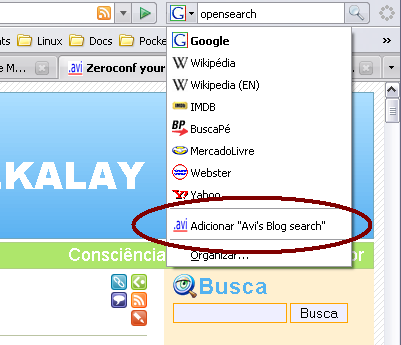
I just came across a Mozilla::Developer page that teaches how to let visitors on a site easily add that site’s search function into their browsers as a plugin.

If you are reading this in my blog and you select your browser’s search tool, this is what you’ll see:

OpenSearch option in browser’s tool

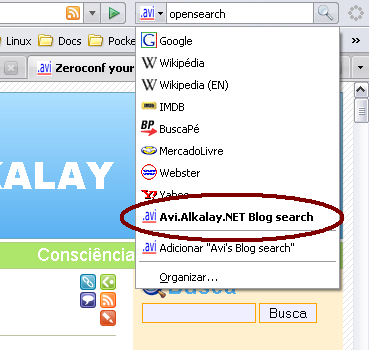
You’ll get the option to permanently add my blog’s search function to your browser. If you select it, you’ll have this:

OpenSearch option added to browser’s tool

To make it, I followed the instructions on the first link and created my OpenSearch description file. Look! Technorati, Microsoft, and many others have OpenSearch-enabled websites.

Linux por todo lado 21 comments By AviPublished: Wed, 21 Nov 2007 11:29:13 -0200 Updated: Thu, 31 Jan 2008 19:30:44 -0200 Published: 21 Nov 2007 Updated: 31 Jan 2008 Published: 11:29 am Updated: 7:30 pm Categories: Linux & Open Source Tags:

Seguindo o espírito de bisbilhotar os sistemas alheios, este feriado observei mais algumas novidades:

Sabrico Volkswagen
Ajudando minha namorada a comprar carro, observei o uso do emulador de terminal seguro PuTTY na loja da Sabrico. Parece que o sistema de estoque e preços deles é centralizado e acessado por SSH. Apertando o olho em partes da tela, uma barra de status mostrava o logon do vendedor e a palavra “LINUX”, provavelmente para indicar a plataforma daquela sua versão do sistema de gestão. Ou seja, esse sistema crítico roda em Linux na Sabrico e é acessado com segurança usando tecnologias Open Source: SSH.

Hospital São Luiz
Encontrei com um amigo antes de uma aula de Yoga. Começou ter dores fortes e acabei levando-o ao pronto socorro do hospital. Como não tinha muito o que fazer, observei novamente o uso do PuTTY nos PCs da sala de enfermagem. No conteúdo da tela não havia muitos indícios de o servidor acessado rodar Linux, mas julguei que a probabilidade era altíssima. Outra coisa que me chamou a atenção foi o nome do servidor acessado pelo PuTTY: SRVIBM. Mais chance ainda de ser Linux, porque todos os servidores da IBM suportam este SO. Agora, há uso mais crítico para Linux do que em um renomado pronto socorro ?

Houve uma época em que empresas gastavam fortunas com licensas de emuladores de terminal, para acessarem seus servidores UNIX. Ah, e eles eram inseguros e sem criptografia, usando telnet puro e simples. Hoje Open Source está, com segurança, de ponta a ponta: do servidor ao emulador. Soluções de segurança são importantes o suficiente para terem que ser um commodity: devem ser baratas e fáceis de usar por toda parte. E o movimento Open Source tem o mérito de ter barateado e “commoditizado” esse mercado.

Parabéns às duas empresas !

E você? Onde mais tem visto o uso de Linux?

ODF versus CDF 5 comments By AviPublished: Mon, 05 Nov 2007 14:14:41 -0200 Updated: Thu, 31 Jan 2008 19:35:22 -0200 Published: 5 Nov 2007 Updated: 31 Jan 2008 Published: 2:14 pm Updated: 7:35 pm Categories: OpenDocument Format Tags:

There are some news popping on the web about ODF to be substituted by W3C’s Compound Document Formats.

Read them carefully, read other sources too and try to understand first before making judgements.

Entities like OpenDocument Foundation are switching opinions in a quest for some sort of Universal Format, that still doesn’t exist, promoting CDF.

CDF is a W3C specification about mixing various XML idioms in one document. Things like SVG or MathML inside XHTML, etc. It is a good thing and an inevitable consequence of XML per se.

In my opinion, CDF is more suited to be used in web browsers and online. Some of its sub-specifications are still unifinished or incomplete — as CSS3, required for essential things like pagination.

The most irritating statement by OpenDocument Foundation is a chart from their site that says some several bizarre things:

  • OOXML would be compatible with legacy MS formats. If they can explain how a textual XML format can be compatible with a binary-only one I can accept it. Well, I won’t because I know they can’t.
  • CDF would be compatible with legacy MS formats. This is even worse. While a OOXML document may have same structure as its MS legacy binary equivalent, CDF is still completely different, built on top of technologies created for completely different purposes. If even OOXML can’t be compatible, CDF for sure isn’t compatible too. This is just a CDF-overselling incorrect argument.
  • ODF does not have an interoperability framework. What an “interoperability framework” means for people that does not even understand what is compatibility? In the Open Standards era, the proper use of them is already a simple path to interoperability. Want more sophisticated ways? Build tools around these Open Standards and you are done.
  • CDF would be big vendor-independent. That’s OK if W3C wants to stay independent. But CDF will go nowhere if no big vendor adopts it. And to be a real viable alternative to ODF it must prove its value to these big vendors.
  • ODF does not converges desktop, server, web and devices. Just one example that kills this argument is Google Docs. They are making a good (server) job letting (web) users upload, edit, maintain and download ODF documents. Google Docs is starting to be available for mobile devices too.

There are some people playing with CDF, mostly developers. Nice articles can be found in IBM developerWorks about it.

A successful format also needs user friendly software that implements it, cause I don’t expect my mother to write rich CDF docs in Notepad. That’s were the importance of OpenOffice.org (and all its derivatives) appear to help the ODF ecosystem.

So yes, use CDF to make great standards-oriented web pages, instead of proprietary Flash or Silverlight. But to say that CDF can be a universal format for office applications and documents is to overload the technology a little bit.

Gartner’s top 10 strategic technologies for 2008 0 comments By AviPublished: Thu, 25 Oct 2007 14:01:46 -0200 Updated: Thu, 31 Jan 2008 19:37:03 -0200 Published: 25 Oct 2007 Updated: 31 Jan 2008 Published: 2:01 pm Updated: 7:37 pm Categories: Info & Biz Technology Tags:

The following is a copy-paste from an e-mail circulating internaly. The content is probably some place on the web, just don’t know where.

  1. Green IT
    This one is taking on a bigger role for many reasons, including an increased awareness of environmental danger; concern about power bills; regulatory requirements; government procurement rules; and a sense that corporations should embrace social responsibility.
    Chip designers have realized that lowering per-core performance by 20% actually cuts power usage in half, so adding cores can improve chip performance and efficiency, Claunch said. But IT is still responsible for 2% of all carbon releases, and it’s coming from many sources. “Fast memory is getting to be a surprisingly high energy consuming item,” Claunch said.
    One of the next steps is taking the power-saving features of mobile devices such as phones and laptops and bringing them to more computing platforms. “We’ve been confronting the power problem on mobile devices for a long time because of those pesky batteries,” he said. “We can take those learnings and put them into servers. In the future, we’ll have servers that will go to sleep if they’re not being used.”
  2. Unified Communications (UC)
    UC functionality is drawing from five core markets: voicemail, PBXs, e-mail and calendaring, IM, and conferencing and collaboration. The key trends are communications becoming IP-based, analog systems switching to digital, and growing integration among voice, network, storage, sensors and video technologies.
    “In a world in which all the information is digital and carried on IP, the opportunity and advantages of carrying it on a unified infrastructure are becoming obvious,” the analysts stated in a slideshow presentation. “Organizational issues must be addressed to take advantage of this unification, because responsibilities and budgets are so often fragmented among groups such as building maintenance, voice communications, data communications and storage administration.”
  3. Business Process Management
    BPM is more of a business discipline than a technology, but is necessary to make sure the technology of service-oriented architectures (SOA) deliver business value, Cearley said. It’s also important for dealing with laws like Sarbanes-Oxley that require business to define processes, he said.
    “SOA and BPM have common objectives,” Cearley said. “They’re both focused on driving agility, driving business process improvement, flexibility and adaptability within the organization. SOA is a key mechanism that makes BPM easier.”
  4. Metadata Management
    Metadata is the foundation for information infrastructure and is found throughout your IT systems: in service registries and repositories, Web semantics, configuration management databases (CMDB), business service registries and in application development.
    “Metadata is not just about information management,” Cearley said. “You need to look beyond that. Metadata is everywhere.”
  5. Virtualization 2.0
    “Virtualization 2.0″ goes beyond consolidation. It simplifies the installation and movement of applications, makes it easy to move work from one machine to another, and allows changes to be made without impacting other IT systems, which tend to be rigid and interlinked, Claunch said.
    There are also disaster recovery benefits, since the technology lets you restack virtual systems in different orders in recovery centers, providing more flexibility. “Virtualization is a key enabling technology because it provides so many values,” Claunch said. “Frankly it’s the Swiss Army knife of our toolkit in IT today.”
  6. Mashups & Composite Applications
    Mashups, a Web technology that combines content from multiple sources, has gone from being a virtual unknown among IT executives to being an important piece of enterprise IT systems. “Only like 18 months ago, very few people (knew what a mashup was),” Cearley said. “It’s been an enormous evolution of the market.”
    U.S. Army intelligence agents are using mashups for situational awareness by bringing intelligence applications together. Enterprises can use mashups to merge the capabilities of complementary applications, but don’t go too far.
    “Examine the application backlog for potential relief via mashups,” the analysts stated in their slideshow. “Investigate power users’ needs but be realistic about their capabilities to use mashups.”
  7. Web Platform & WOA
    Web-oriented architecture, a version of SOA geared toward Web applications, is part of a trend in which the number of IT functions being delivered as a service is greatly expanding. Beyond the well-known software-as-a-service, Cearley said over time everything could be delivered as a service, including storage and other basic infrastructure needs.
    “This really is a long-term model that we see evolving from a lot of different parts of the market,” Cearley said. It’s time for IT executives to put this on their radar screens and conduct some “what-if” scenarios to see what makes sense for them, he said.
  8. Computing Fabrics
    Today’s blade server design places memory and processors into a fixed combination inside a blade, and until recently neither memory or processors from one blade could be combined with that of other blades.
    New server designs will allow several blades to be merged across a “computing fabric,” in which they will appear as a single server to an operating system.
    “The fabric based server of the future will treat memory, processors and I/O cards as components in a pool, combining and recombining them into particular arrangements to suit the owner’s needs,” the analysts wrote. “This evolution will simplify the provisioning of capacity to meet growing needs.”
  9. Real World Web
    Increasingly ubiquitous network access with reasonably useful bandwidth is enabling the beginnings of what analysts are calling the “real world Web,” Claunch said. The goal is to augment reality with universal access to information specific to locations, objects or people. This might allow a vacationer to snap a picture of a monument or tourist attraction and immediately receive information about the object, instead of flipping through a travel book.
  10. Social Software
    Social software like podcasts, videocasts, blogs, wikis, social bookmarks, and social networking tools, often referred to as Web 2.0, is changing the way people communicate both in social and business settings.
    “It’s really been empowering people to interact in an electronic medium in a much richer fashion than we did with e-mail or corporate collaboration systems,” Cearley said.
    The effectiveness of these tools for enterprise use varies, and some tools that have the potential to improve productivity aren’t yet mature enough for enterprise use, Gartner says. For example, wikis are highly valuable and mature enough for safe and effective enterprise use. Meanwhile, Gartner says prediction markets potentially have a lot of enterprise value but so far have low maturity. Podcasts, conversely, can be used safely and effectively but don’t have a lot of business value, the analyst firm said.
Linux Pin-ups and Anime 8 comments By AviPublished: Fri, 12 Oct 2007 08:04:40 -0300 Updated: Thu, 31 Jan 2008 19:39:39 -0200 Published: 12 Oct 2007 Updated: 31 Jan 2008 Published: 8:04 am Updated: 7:39 pm Categories: Linux & Open Source Tags:

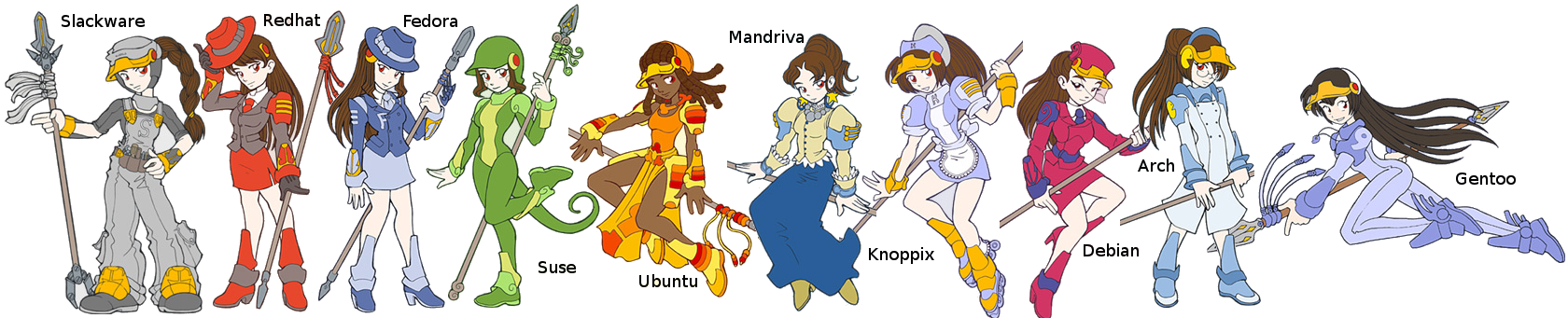
Have you seen this? Juzo-kun has created beautiful girls to represent Linux distributions. They were later labeled by Wayne Richardson.

Linux distributions represented in Anime form

Full version of this graphics, separated by distro, are here.

Cross-culture things like that are cool. Now lets just wait for a Pin-up version.

Flash Player now supports advanced MPEG-4 content 10 comments By AviPublished: Thu, 11 Oct 2007 14:06:12 -0300 Updated: Sun, 02 Mar 2008 09:58:22 -0300 Published: 11 Oct 2007 Updated: 2 Mar 2008 Published: 2:06 pm Updated: 9:58 am Categories: MultimediaWeb 2.0 Tags:

Adobe’s press release says it all: lab version of o Flash Player 9.0 supports latest and best multimedia technologies.

Thanks to YouTube and other online video services, the Adobe Flash Player browser plug in is probably the most popular video player in the world. But before this version, only the proprietary and now inefficient FLV format was supported.

Tinic Uro, a multimedia software engineer at Adobe explains that the Player now supports:

  • H.264/MPEG-4 AVC
    The best, most sofisticated and advanced video codec, capable of high quality, low bitrate video performances. H.264 is the standard for HD-TV, HD-DVD and BluRay. H.264 is better than MPEG-4 ASP/Xvid/DivX.
  • AAC and HE-AAC (a.k.a AAC SBR)
    The ISO successor of MP3, for audio. MP3 is already very good, extremely popular, and still supported by the MPEG-4 ISO standard and Flash Player. There is no practical advantage on AAC over MP3 for the music you load in your portable player, but HE-AAC achieves much better quality on very low bit rates (desired for streaming) than MP3.
  • MP4 file format
    The MP4 container was designed for many types of usages, including streaming over the Internet. An MP4 file can carry many video, audio, subtitle, scripting, VRML, XML and other metadata multiplexed and in parallel.

All this formats are parts of the ISO MPEG-4 standard.

This is a much expected update for the Flash Player and its users. Every new video on YouTube is being compressed with this technologies since June and the old ones will be converted over time.

We will see quality and speed improvements in multimedia content happening in the right way. Also, the formats of the video files people exchange will converge into a single one based on MPEG-4 standards: MP4 files containing higher-quality-for-megabyte H.264, AAC and subtitle streams.

This is also good news for the Linux and open community. A number of good MPEG-4 related authoring tools already exist and are maturing fast: x264 for video compression, FAAD/FAAC for audio, and GPAC and others for MP4.

Escolhendo uma Distribuição Linux 17 comments By AviPublished: Tue, 04 Sep 2007 20:58:29 -0300 Updated: Thu, 31 Jan 2008 19:46:18 -0200 Published: 4 Sep 2007 Updated: 31 Jan 2008 Published: 8:58 pm Updated: 7:46 pm Categories: EssaysLinux & Open Source Tags:

É importante começar dizendo que todas as distribuições Linux, incluindo as comerciais — Red Hat Enterprise Linux, SUSE Linux, Xandros, etc — e não-comerciais — Debian, Slackware, Gentoo, etc — atendem a maioria das necessidades reais. Escolher uma melhor entre elas é mais uma questão de gosto pessoal do técnico que já a conhece do que de funcionalidades. Mas uma empresa precisa pesar mais aspectos — além do gosto — para garantir uma escolha estratégica de benefícios de longo prazo.

Suporte e Certificação

Todas as distribuições Linux empacotam, de uma forma ou de outra, mais ou menos os mesmos softwares Open Source (o Kernel, Apache, Samba, bibliotecas, Gnome, KDE, etc). Mas somente as chamadas distribuições chamadas enterprise incluem suporte junto ao seu produto.

Para um usuário, suporte significa:

  1. Um parceiro disponível agora e no longo prazo, para transferir riscos operacionais
    Este é o ponto mais importante. Empresas não querem tomar riscos — especialmente os riscos inerentes ao Open Source.

  2. Acesso rápido a atualizações de qualidade
    Empresas em geral tem recursos limitados para compilar, testar e integrar atualizações de software Open Source.

  3. Acesso a um grande número de fabricantes independentes de hardware (IHV) e de software (ISV) certificados e disponibilidade de soluções complexas pré-testadas
    Uma parte crítica de qualquer projeto de TI consiste em correlacionar a certificação entre seus componentes (hardware, storage, middleware, SO, etc). A característica mais importante e valorizada que uma distribuição pode prover, mais do que as tecnologias embutidas no SO, é a sua capacidade de criar ecossistemas de hardware e software homologado.

Modelo de Subscrição versus Preço por Licença

Empresas que vendem software comercial (como a Microsoft, IBM, Oracle, etc) vão permitir o uso de seus produtos somente após a compra de um direito de uso. Esses “direitos compráveis” são hoje em dia chamados de licença comercial.

O software contido em qualquer distribuição Linux é sem custo. Os desenvolvedores desses softwares licenciaram seu trabalho sob a GPL, BSD, Mozilla Public, IBM Public ou alguma outra licença Open Source, que garante a qualquer um o direito de usar e redistribuir o software sem ter que pagar por isso.

É errado dizer que se “compra” uma distribuição Linux (ou uma licença de seu uso). Não se pode comprá-la. Na prática ela já é sua. É como dizer que um usuário irá comprar o conteúdo de um site. Não há nada material para adquirir. Por outro lado, o que sim pode-se dizer é que se está assinando um serviço que provê assistência técnica, acesso a atualizações, e ingresso a um ecossistema de produtos que inter-operam de uma forma pré-testada e certificada — os pontos de suporte pincelados anteriormente.

Então empresas que fazem distribuições enterprise (como Red Hat, Novell, Xandros) vendem esse serviço, e não o software, porque o último é gratuito.

Escolhendo a Melhor Distribuição

Há duas formas responsáveis e maduras de usar alguma distribuição Linux nas operações de TI de uma empresa:

  1. Adquirir subscrição de uma distribuição enterprise global como as vendidas pela Red Hat e Novell
    A subscrição atrela o software Open Source a um suporte de escala global, criando ambiente estável e favorável para o florescimento de um ecossistema de ISVs e IHVs certificados.
  2. Usar distribuições gratuitas como Debian ou Slackware, e adquirir serviços de suporte de uma companhia local, independente
    Isso pode trazer mais risco por causa da operação de suporte não-global, e falta de integração entre o empacotamento do software e seu suporte, o que leva a um ecossistema fraco ou inexistente de ISVs e IHVs.

Em termos de flexibilidade técnica e escolha de fornecedor — pontos que impactam em custo —, as duas opções são iguais. Todos os benefícios da segunda opção estão presentes na primeira, enquanto na segunda estão ausentes os aspectos de ecossistema de ISVs e IHVs da primeira.

RHEL versus SLES

Para uma empresa que precisa tomar decisões pragmáticas, parece fazer mais sentido adquirir diretamente um produto como o RHEL e SLES, que atrela suporte ao software na fonte, do que manualmente integrá-los em níveis regionais. A segunda opção, com Debian etc, também tem sido escolhida com sucesso por empresas principalmente do setor público, e trazem benefícios sociais e econômicos gerais por manterem o dinheiro circulando dentro do país.

Empresas devem prestar atenção aos seguintes pontos, mais ou menos nesta ordem, quando estão escolhendo uma distribuição Linux para rodar suas aplicações de negócio:

  1. Com qual fabricante de distribuição eu tenho melhores relacionamentos comerciais ?
  2. Qual fabricante tem melhor preço de subscrição pelo valor oferecido ?
  3. Qual distribuição meus técnicos conhecem melhor ?
  4. Qual distribuição é suportada e certificada por quem me fornece produtos de hardware e software ?
  5. A não ser que se saiba muito bem o que se está fazendo, empresas devem ser responsáveis e usar distribuições enterprise.

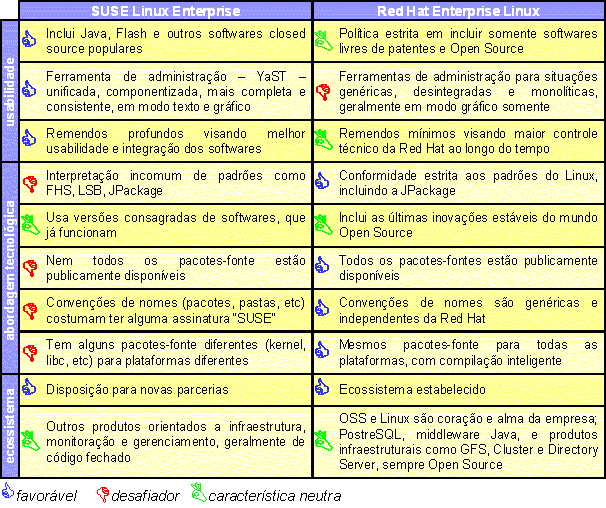
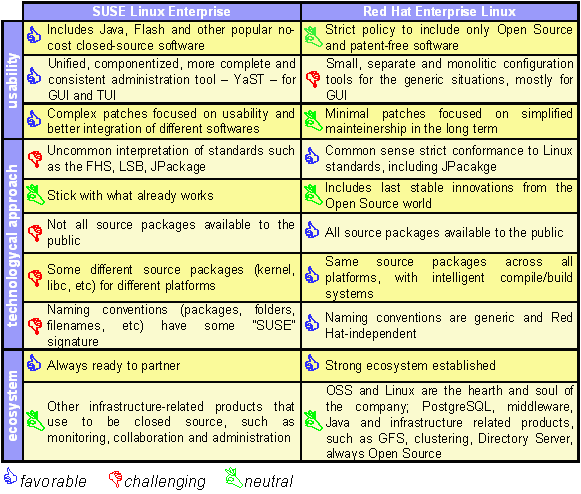
Para empresas que precisam escolher rapidamente uma distribuição, há duas opções enterprise que tem um forte ecossistema e penetração no mercado: Red Hat Enterprise Linux e Novell SUSE Linux Enterprise. Umas poucas diferenças entre elas tem se tornado cada vez maiores ao longo do tempo, mas a maioria das diferenças tem convergido ou desaparecido. Veja uma comparação na tabela.

Outras Distribuições Enterprise

Há alguns provedores de distribuições Linux com modelos de negócio similar ao adotado pela Red Hat e Novell. As mais famosas são Ubuntu (tecnicamente baseado no Debian), Mandriva (fusão da Conectiva, Mandrake e outras), Xandros (também baseado no Debian), para citar algumas. Elas estão focadas em prover um produto global de tal forma que suporte e serviços possam ser disponibilizados automaticamente ou num modo self-service.

Há uma lei intrínseca do mercado que busca o equilíbrio lançando mão de duas opções de escolha. Uma opção pode ser boa (na verdade não há opção quando só existe um caminho), duas opções maduras é melhor, mas três ou mais opções já é demais para o mercado digerir. E parece que o mercado já definiu suas duas escolhas maduras com a Novell e Red Hat.

Mesmo se essas outras distribuições enterprise tiverem produtos melhores, elas terão que investir uma quantidade considerável de energia construindo um ecossistema de ISVs e IHVs. Mais do que isso, ISVs e IHVs terão que fazer uma pausa em suas operações para ouvir o que estas novas distribuições tem a oferecer.

Ecossistema é tudo que importa. Um produto com um bom ecossistema pode facilmente se tornar melhor que um excelente produto sem ecossistema. Provavelmente este é o aspecto mais importante a considerar quando uma companhia escolhe uma distribuição.

Não se pode dizer que certa distribuição é melhor que todas as outras. Deve-se sempre colocar na balança aspectos pragmáticos visando uma boa aderência a sua empresa ou a um certo projeto.

Basic Subversion Repository Management 3 comments By AviPublished: Fri, 31 Aug 2007 06:22:51 -0300 Updated: Thu, 31 Jan 2008 19:47:42 -0200 Published: 31 Aug 2007 Updated: 31 Jan 2008 Published: 6:22 am Updated: 7:47 pm Categories: Linux & Open Source Tags:

(This is a shared personal note, suggestions are welcome.)

Create a Subversion repository for a project, say The SVG Blog Icons:

  1. Create the repository on the hosting panel with a project name (e.g. Blog Icons) and project ID (e.g. blogicons).
  2. Import the files:
    bash$ cd src/
    bash$ ls
    blogicons
    bash$ export EDITOR=vi
    bash$ svn -m "First import" import blogicons http://svn.alkalay.net/blogicons/trunk
  3. Start over with a fresh copy:
    bash$ mv blogicons blogicons.old
    bash$ svn co http://svn.alkalay.net/blogicons/trunk blogicons
  4. Create a repository for pointers to official releases and register the official release the files imported represent:
    bash$ svn -m "Links of official releases" mkdir http://svn.alkalay.net/blogicons/tags
    bash$ svn -m "Official 20070518 version" cp http://svn.alkalay.net/blogicons/trunk http://svn.alkalay.net/blogicons/tags/20070518
  5. Check how it looks pointing the browser to http://svn.alkalay.net/blogicons/

Manage project files:

  • Add files
    bash$ cd blogicons
    bash$ svn add newfile.svg
    bash$ svn add newfiles.*
  • Remove files
    bash$ cd blogicons
    bash$ svn rm oldfile.svg
    bash$ svn rm oldfiles.*
  • To embed the file’s meta information in itself as a comment
    bash$ cd blogicons
    bash$ echo "<!-- $Id$ -->" >> file.xml
    bash$ echo "/* $Id$ */" >> file.c
    bash$ echo "// $Id$" >> file.cpp
    bash$ echo "# $Id$" >> file.sh
    bash$ echo "# $Id$" >> Makefile
    bash$ svn propset svn:keywords Id file.xml file.c file.cpp file.sh Makefile

    Every time changes and commits happen, the $Id$ tag will be replaced as this examples:

    <!-- $Id: file.xml 148 2007-07-28 21:30:43Z username $ -->
    /* $Id: file.c 148 2007-07-28 21:30:43Z username $ */
    // $Id: file.cpp 148 2007-07-28 21:30:43Z username $
    # $Id: file.sh 148 2007-07-28 21:30:43Z username $
    # $Id: Makefile 148 2007-07-28 21:30:43Z username $

    People use to put the $Id$ tag in the beginning of source files. The example show how to put in the end, but that’s because it is easy to represent it here in the documentation. You should put $Id$ tags in the beginning of the file.

  • Commit changes to repository
    bash$ cd blogicons
    bash$ svn -m "Changed color to red on icon A, moved the circle shape to left on icon C" commit

    Use descriptive comments favoring WHAT changed on files and not which files changed.

OOXML: Brazil Says NO 55 comments By AviPublished: Thu, 23 Aug 2007 13:34:20 -0300 Updated: Mon, 24 Mar 2008 10:29:28 -0300 Published: 23 Aug 2007 Updated: 24 Mar 2008 Published: 1:34 pm Updated: 10:29 am Categories: OpenDocument Format Tags:

After a very difficult and inconclusive meeting in ABNT (Brazilian Technical Standards Organization) office last tuesday, the standards process director had to analyze the audio recording of all the meeting, review some facts, review again all 63+2 comments produced by the technical group about the ECMA specification, and conclude that a NO for OOXML is the correct position for Brazil in ISO Fast Track process.

Brazil will fill the ISO form with a NO and will attach the 63+2 technical comments to it.

I was a member of the technical group that have studied OOXML specification extensively. I learned that it is unbelievable how ECMA (same guys that put together the JavaScript standard!) can think that a wannabe spec like OOXML is ready for submission. It is incomplete (does not provide mappings with legacy standards, since compatibility is OOXML goal), too long (6000+ pages), fully tied to a single product, uses deprecated substandards, promotes bad practices (embedded binary objects), has clear proprietary hooks (like “formatAsWord95″ XML tags), reinvents the wheel all around (date and color formats etc), and most of all does not have a standards-grade look and feel required for a universal and (virtually) eternal document format (doesn’t have to be perfect, but can’t be that imperfect).

Shame on you, ECMA. Your position as a trusted standards organization was severely damaged.

In my opinion, the YES-voting countries are not reading the OOXML specification, are making a pure political decision or simply don’t have a standardization process. This is not to mention that they completely ignored the fact that a similar standard — ODF — already exists. Neither is the case of Brazil and our ABNT.

Countries that will absent their vote probably had a tough time in the decision process with a lot of conflicts between political ramblings and technical facts. This was almost the case for Brazil and our ABNT, but we got the courage to do the right thing.

In parallel, ABNT is turning the OpenDocument Format into a national standard and will adopt and promote as it is: a truly open, universal and independent format for digital documents.

This is a happy day.

Media news that link here (a.k.a. egotrip):

Links to other sources:

Impressões Sobre Reunião Final da ABNT 18 comments By AviPublished: Wed, 22 Aug 2007 00:03:40 -0300 Updated: Thu, 31 Jan 2008 19:54:09 -0200 Published: 22 Aug 2007 Updated: 31 Jan 2008 Published: 12:03 am Updated: 7:54 pm Categories: OpenDocument Format Tags:

Era uma incógnita absoluta como iria terminar a reunião de votação do OOXML. E de fato terminou de forma inédita.

Não é responsabilidade da ABNT definir tecnicamente um padrão, e sim somente estabelecer e liderar o processo para que os interessados da sociedade decidam sobre ele.

Hoje a ABNT viveu uma reunião como nenhuma outra em sua história, acredito. As opiniões estavam tão divididas e irredutíveis que Eugênio, o diretor de normatização, teve que assumir uma posição de muita responsabilidade e ele próprio decidir pelo voto baseado nos relatos gravados da reunião. Ele teve presença de espírito suficiente para perceber que a discussão poderia demorar mais 8 semanas e não chegar num consenso.

O processo funciona mais ou menos assim:

  1. A ECMA/Microsoft submeteu a especificação OOXML para se tornar uma norma ISO.
  2. A ISO instala o processo Fast Track onde as National Bodies (ABNT no caso do Brasil) de vários países analisam a qualidade da especificação para votar SIM, NÃO ou abstenção na ISO. Votos SIM e NÃO podem vir acompanhados de comentários.
  3. A ABNT criou um Grupo de Trabalho (GT2) a uns meses atrás para fazer um estudo técnico do OOXML. Participaram do estudo empresas e entidades a favor e contra o OOXML. Eu participei pela IBM.
  4. O trabalho do GT2 como um todo se consolidou em 63 comentários de melhoria à especificação, mais 2 comentários muito polêmicos que foram tratados de forma separada, mais algumas dezenas de comentários muito pertinentes que ou não houve tempo de incluí-los na mesma lista dos 63, ou concordou-se que deveriam ficar de fora. Esse trabalho terminou nesta segunda, 20 de agosto, um dia antes da reunião de hoje.
  5. O processo da ABNT dita que para eliminar um desses 63+2 comentários técnicos, deve-se apresentar uma contraposição fundamentada. Caso contrário, tal comentário é categorizado como um consenso de que é válido. Este é um ponto muito importante do processo.
  6. Há quem ache que os comentários não são relevantes, e nesse caso vota SIM ou SIM com os comentários. E há quem ache que são relevantes, e no caso vota NÃO ou NÃO com os comentários.

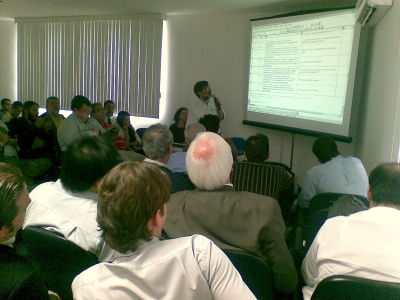
Fernando Gebara repassando os 63 comentários.Os 63 comentários foram lidos na parte da manhã e gastamos quase a tarde inteira para discutir calorosamente somente um dos 2 comentários polêmicos. Soa como discutir o sexo dos anjos: ninguém parece estar errado nem certo.
No fim do dia, Eugênio voltou para o desenrolar e se deparou com uma total indefinição. Analisou rapidamente a situação e colocou a reunião num trilho de raciocínio lógico. Primeiro constatou que todos concordavam com os 63 comentários e que eles não tinham contraposições fundamentadas. Depois verificou que as pessoas não queriam que a posição do Brasil fosse abstenção. Sobrou o SIM ou o NÃO.

A Microsoft e algumas empresas parceiras não aceitavam um NÃO mas ao mesmo tempo concordaram que os comentários eram pertinentes. Corinto Meffe, do Ministério do Planejamento, argumentou, e todos concordaram, que comentários anexos a um NÃO teriam mais força de transformação da especificação do que os mesmos acompanhados por um SIM. Neste último caso, não se sabe se a ECMA/Microsoft iriam acata-los, o que desvalorizaria o trabalho do GT2 e a opinião técnica do Brasil no mundo. O NÃO com comentários fazia mais sentido. Aparentemente inclusive aos olhos do Eugênio.

Era evidente o balanço de opiniões. Todas as empresas e instituições governamentais como MCT, ITI, MP, Banco do Brasil, Caixa Econômica, Correios, Serpro, Celepar, etc, mais organizações como BrOffice.org, Rede Livre, ODF Alliance, mais empresas do calibre da Sun, Red Hat, 4Linux, IBM, Metrô de São Paulo, Google e outras, votariam NÃO.

O SIM era mantido pela Microsoft, UNESP, SUCESU-SP, Associação de Parceiros Microsoft, e mais uma porção de empresas regionais ou de alcance menor.

Numa votação informal deu 27 NÃOs e 24 SIMs. Mas isso não representa a sociedade, e o objetivo é chegar a um consenso, e não resultado por votação.

Eugênio assumiu uma missão para as próximas horas. Ele deve analisar o teor dos argumentos na reunião e provavelmente medir o peso das divergências. Por exemplo, talvez ele calcule que o opinião de um parceiro regional da Microsoft tem uma relevância mais focada que o de uma empresa global como o Google, ou não estaria tão sintonizado com os desejos intrínsecos da sociedade em geral como as instituições públicas.

Isso é um exemplo de critério que faz sentido para mim, mas não sei que linha ele vai tomar. E é importante não pressionar a ABNT nem o Eugênio por que é comprovadamente uma questão muito difícil.

De qualquer forma, tudo indica, mas sem nenhuma certeza, que o Brasil dará um NÃO com comentários ao OOXML.

Há especulações que outros fatores podem influenciar a decisão final. Mas na minha opinião, o processo da ABNT tem sentido e lógica, é bem formal, e foi seguido na medida do possível. Aos meu olhos somente o processo em sí, e nenhum outro fator político externo, definiram o trilho para se chegar ao voto do Brasil.

Seja qual for, vamos saber nas próximas horas, e não vamos cantar vitória antes disso.

MacBooks at IBM 1 comment By AviPublished: Sat, 04 Aug 2007 19:59:07 -0300 Updated: Tue, 10 Jun 2008 18:59:40 -0300 Published: 4 Aug 2007 Updated: 10 Jun 2008 Published: 7:59 pm Updated: 6:59 pm Categories: Info & Biz Technology Tags:

I spend the first week of this trip to US in IBM Somers campus, a set of buildings where most of the company’s head quarters are located.

I went to many meetings with people in the CIO organization, IBM Academy of Technology and others, and surprisingly many high level people have MacBooks as their primary laptops. No Thinkpads, no Windows. I also noticed there is an internal Mac@IBM community with an Intranet home page, forums etc.

Although, for historical reasons, our official platform for desktops and laptops is still Windows, current IBM strategy for this matter is something like “hey, use whatever platform, browser, office suite, etc you want, because we are heading towards an Open Standards way”. This is called [cultural] diversity.

This is good, I like it, and this is the spirit that our internal Linux deployment relies on. Compared to Mac, Linux has a bigger community of users, more fully supported internal applications, and more internal developers. But I can say that Macs are more popular amongst VIPs.

The basic minimal software kit for IBM employees is Lotus Notes for workgroup, Sametime for instant messaging, a standard compliant browser as Firefox, and maybe some office suite. Well, Firefox runs everywhere, Sametime is 100% Java, Lotus Notes 8 is based on Java Eclipse and integrates an office suite compatible with OpenDocument Format (OK, is actually OpenOffice.org 2 embeded in Lotus Notes). So the kit runs everywhere, including Windows, Mac, Linux and many mobile platforms (which are also internally encouraged to be used for supermobile workers). Many employees only use this minimal set of tools.

A few more interesting words about Sametime: its being integrated with our global voice infrastructure through VoIP standards as SIP, so you can call any extension in the world using the IP network. You also carry your extension with you wherever you go. The instant messaging tool is the right place for it because it is already very well integrated with our enterprise directory. So we search people, find and chat (by typing) or talk.

Yes, for historical reasons we also use many products based on proprietary technologies. At the time they were chosen Open Standards were not something in the global agenda yet. Or they implement some sort of needed disruptive technology that didn’t have a viable standards-based equivalent. This is the case for the Siebel CRM used by the sales force. Completely proprietary but unique and fulfills our business features.

Although disruptive and proprietary use to walk together in the ICT front, IBM as a technology consumer has been putting Open Standards in its complex equation of what things to buy and use. This may be easy for a small company, but is a huge step for a big enterprise as IBM. And is, in my opinion, an example to be followed.

Nos Domínios da Paravirtualização 3 comments By AviPublished: Fri, 29 Jun 2007 00:13:14 -0300 Updated: Thu, 13 Mar 2008 21:16:50 -0300 Published: 29 Jun 2007 Updated: 13 Mar 2008 Published: 12:13 am Updated: 9:16 pm Categories: EssaysInfo & Biz Technology Tags: